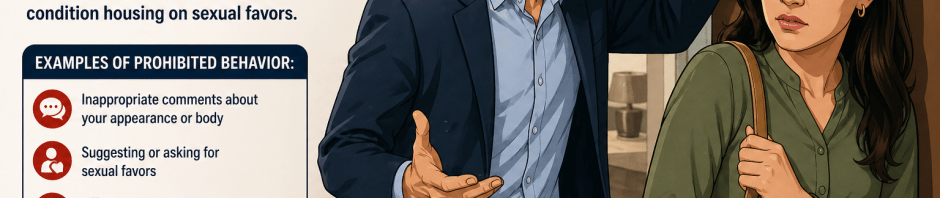
The Justice Department announced April 27, 2026 that residential rental property owner and manager Joseph E. Johnson, will pay $510,000 to resolve a lawsuit alleging that he sexually harassed female tenants in violation of the Fair Housing Act.
A new consent order and settlement obtained by Justice Department reminds housing and other businesses that federal requirements to prevent sexual harassment and other federal civil rights and discrimination laws don’t only protect employees.
Federal Sexual Harassment Laws Extend Beyond Employment
The Fair Housing Act and other federal laws also can require businesses to take appropriate steps to protect tenants and other customers and others doing business with their business against unwelcome sexual advances and other discrimination in their businesses.
Sexual harassment is recognized as sex discrimination under the Fair Housing Act and other civil rights laws. Fair Housing Act liability may extend to:
- Property owners;
- Management companies; and
- Individual agents.
Victims may:
- File a complaint with HUD (Office of Fair Housing and Equal Opportunity) or Justice Department:
- Pursue state or local fair housing remedies; or
- Bring civil litigation for damages, injunctive relief and attorneys’ fees.
Under the FAIR housing Act (42 U.S.C. § 3601 et seq.), prohibited housing harassment ccurs when a landlord, property manager, or agent engages in unwelcome conduct based on sex (or other protected status) that:
- Conditions housing benefits on compliance (“quid pro quo”), or
- Creates a hostile, intimidating, or offensive living environment.
Examples include:
- Rent-for-favors” or repair-for-favors propositions;
- Repeated unwanted comments, texts, or visits;
- Threats of eviction or adverse treatment for refusal; or
- Retaliation after rejecting advances or reporting conduct.
Johnson Consent Decree Illustrates Risks
The settlement and resulting consent order with Johnson resolves a Justice Department lawsuit against landlord Joseph E. Johnson, in the U.S. District Court for the Eastern District of Kentucky in December 2024, that alleges that Johnson sexually harassed female tenants for decades, including in their homes and at the rental office. The suit alleged that Johnson offered to forgive rent in exchange for sexual contact, demanded sexual contact from his tenants, subjected tenants to unwelcome sexual touching, made unwelcome sexual comments and sexual advances, let himself into female tenants’ homes without notice or permission, and threatened to evict tenants who refused his demands. The complaint also alleges Johnson failed to stop his employees when they engaged in similar conduct.
Pursuant to the consent order, approved by the District Court April 27, Johnson must pay $500,000 to tenants harmed by his harassment and a $10,000 civil penalty to the United States. In addition, the consent order permanently bars Johnson from managing residential rental properties and from contacting tenants harmed by his harassment. It also mandates training and the adoption of policies and procedures to prevent future discrimination in his rental properties.
The Johnson settlement and consent decree are the result of the Justice Department Sexual Harassment in Housing Initiative launched in October 2017, which seeks to address and raise awareness about sexual harassment by landlords, property managers, maintenance workers, loan officers and other people with control over housing under the Fair Housing Act. Since launching the initiative, the department has filed 52 lawsuits alleging sexual harassment in housing and recovered over $19 million for victims of such harassment.
The Fair Housing Act is one of several federal laws that prohibit sexual harassment and other sex and other discrimination enforced by the Justice Department or other federal authorities.
The Civil Rights Division of the Department of Justice and the Department of Housing and Urban Development (“HUD”) enforce the Fair Housing Act and other federal statutes prohibiting discrimination on the basis of race, color, sex, disability, religion, familial status, national origin, and citizenship status.
Since its establishment, the Justice Department Civil Rights Division has grown dramatically in both size and scope, and has played a role in many of the nation’s pivotal civil rights battles. Division attorneys prosecuted the defendants accused of murdering three civil rights workers in Mississippi in 1964, and were involved in the investigations of the assassinations of Dr. Martin Luther King, Jr., and Medgar Evers.
As the Justice Department announcement of the Johnson consent order and enforcement actions like the Johnson litigation and consent decree demonstrate, the Justice Department is committed to similarly enforce federal sexual harassment laws against landlords and other residential housing industry businesses regulated by the Fair Housing Act.
“The Justice Department will not tolerate violations of our federal fair housing laws, including landlords’ unwelcome sexual advances and requests for sexual favors,” said Assistant Attorney General Harmeet K. Dhillon of the Justice Department’s Civil Rights Division. “This settlement demonstrates our commitment to continuing to enforce these laws so tenants remain safe and secure in their homes.”
“No one should have to choose between homelessness and sexual harassment in the place where they should feel safest,” said First Assistant U.S. Attorney Jason Parman for the Eastern District of Kentucky. “Our office is committed to holding accountable anyone who preys on and harasses vulnerable tenants in Eastern Kentucky, and this settlement sends a clear message that sex discrimination in housing will not be tolerated.”
Manage Exposure
Along with continuing to prohibit sexual harassment in employment, residential housing and other businesses should take well documented steps to manage their lability exposures under these laws. Along with posting and including their policies against sexual harassment and other prohibited discrimination in leases, loan documents and other materials, businesses should adopt, train workers, and take consistent, well-documented actions to investigate and enforce clear policies prohibiting sexual harassment against both employees and others by their employees and representatives. Other key elements of these efforts include without limitations
- Written anti-harassment harassment policies extending to housing arrangements and other customer and business relationships;
- Training for leasing agents and staff;
- Postings and other communication of prohibitions and reporting processes in tenant contracts, offices and other materials;
- Vendor due diligence and contractual protections;
- Clear reporting channels;
- Centralized complaint reporting;
- Prompt investigation protocols; and
- Consistent, meaningful discipline
The author of this update, Cynthia Marcotte Stamer has decades of experience advising, investigating, and representing governmental and private organizations in Justice Department, EEOC, the Department of Housing and Urban Development, the Department of Health and Human Services, and other agency civil rights regulatory investigation and enforcement actions of sexual and other harassment, sex, race, disability and other discrimination as well as other legal and operational compliance, risk management and enforcement matters. If you have questions or need advice or help evaluating or addressing these or other compliance, risk management, or other concerns, contact her.
For More Information
We hope this update is helpful. For more information about these or other legal, contractual or operational compliance or risk management, please contact the author Cynthia Marcotte Stamer via e-mail or via telephone at (214) 452-8297.
Solutions Law Press, Inc. invites you receive future updates by registering on our Solutions Law Press, Inc. Website and participating and contributing to the discussions in our Solutions Law Press, Inc. LinkedIn SLP Health Care Risk Management & Operations Group, HR & Benefits Update Compliance Group, and/or Coalition for Responsible Health Care Policy.
About the Author
Recognized by her peers as a Martindale-Hubble “AV-Preeminent” (Top 1%) and “Top Rated Lawyer” with special recognition LexisNexis® Martindale-Hubbell® as “LEGAL LEADER™ Texas Top Rated Lawyer” in Health Care Law and Labor and Employment Law; as among the “Best Lawyers In Dallas” for her work in the fields of “Labor & Employment,” “Tax: ERISA & Employee Benefits,” “Health Care” and “Business and Commercial Law” by D Magazine, Cynthia Marcotte Stamer is a practicing attorney board certified in labor and employment law by the Texas Board of Legal Specialization and management consultant, author, public policy advocate and lecturer widely known for her more than 35 years of health industry and other management work, public policy leadership and advocacy, coaching, teachings, and publications including leading edge work on workforce and other risk management and compliance.
Ms. Stamer’s work throughout her career has focused heavily on working with businesses domestically and internationally on employment, benefits, technology, data confidentiality, privacy, and security, and other Federal Sentencing Guidelines and other workforce management, regulatory and public policy and other legal and operational concerns.
Author of many highly regarded compliance, training and other resources on these and other operations, risk management, compliance and government affairs concerns, Ms. Stamer is widely recognized for her thought leadership and advocacy on these matters.
In addition, Ms. Stamer currently or previously served as the American Bar Association (“ABA”) Joint Committee on Employee Benefits OCR annual agency scribe and a Council Representative, International Section International Employment Law Committee Chair and International Life Sciences and Health Committee Chair, ABA TIPS Medicine and Law Committee Chair, ABA Health Law Section Managed Care & Insurance Interest Group Chair, former Vice President and Executive Director of the North Texas Health Care Compliance Professionals Association, past Board President of Richardson Development Center (now Warren Center) for Children Early Childhood Intervention Agency, past North Texas United Way Long Range Planning Committee Member, and past Board Member and Compliance Chair of the National Kidney Foundation of North Texas, and a host of other professional and civic leadership roles. She is a Fellow in the American College of Employee Benefit Counsel, the American Bar Foundation and the Texas Bar Foundation, Ms. Stamer also shares her extensive publications and thought leadership as well as leadership involvement in a broad range of other professional and civic organizations.
About Solutions Law Press™
Solutions Law Press™ provides health care, human resources and employee benefit and other business risk management, legal compliance, management effectiveness and other coaching, tools and other resources, training and education on health care, leadership, governance, human resources, employee benefits, data security and privacy, insurance, and other key compliance, risk management, internal controls and operational concerns. If you find this of interest, you also be interested reviewing some of our other Solutions Law Press™ resources.
If you or someone else you know would like to receive future updates about developments on these and other concerns, please be sure that we have your current contact information including your preferred e-mail by creating your profile here.
NOTICE: These statements and materials are for general information and purposes only. They do not establish an attorney-client relationship, are not legal advice or an offer or commitment to provide legal advice, and do not serve as a substitute for legal advice. Readers are urged to engage competent legal counsel for consultation and representation considering the specific facts and circumstances presented in their unique circumstance at the particular time. No comment or statement in this publication is to be construed as legal advice or admission. The author reserves the right to qualify or retract any of these statements at any time. Likewise, the content is not tailored to any particular situation and does not necessarily address all relevant issues. Because the law constantly and often evolves, subsequent developments that could impact the currency and completeness of this discussion are likely. The author and Solutions Law Press, Inc. disclaim and have no responsibility to provide any update or otherwise notify anyone of any fact or law specific nuance, change, limitation, or other condition that might affect the suitability of reliance upon these materials or information otherwise conveyed in connection with this program. Readers may not rely upon, are solely responsible for, and assume the risk and all liabilities resulting from their use of this publication.
Circular 230 Compliance. The following disclaimer is included to ensure that we comply with U.S. Treasury Department Regulations. Any statements contained herein are not intended or written by the writer to be used, and nothing contained herein can be used by you or any other person, for the purpose of (1) avoiding penalties that may be imposed under federal tax law, or (2) promoting, marketing or recommending to another party any tax-related transaction or matter addressed herein.
©2026 Cynthia Marcotte Stamer. Non-exclusive right to republish granted to Solutions Law Press, Inc.™ For information about republication, please contact the author directly. All other rights reserved.

 Cynthia Marcotte Stamer
 slproc.com